Shed-roof plants
Metal-sheet and RCC roof mounting with non-penetrative or sealed-penetration fixings, engineered for the sheet gauge and purlin spacing you actually have.
Grid-tied rooftops, hybrid systems with storage, ground-mount plants, commercial and industrial projects, and the long-term maintenance that keeps all of them performing.
01 — Rooftop solar
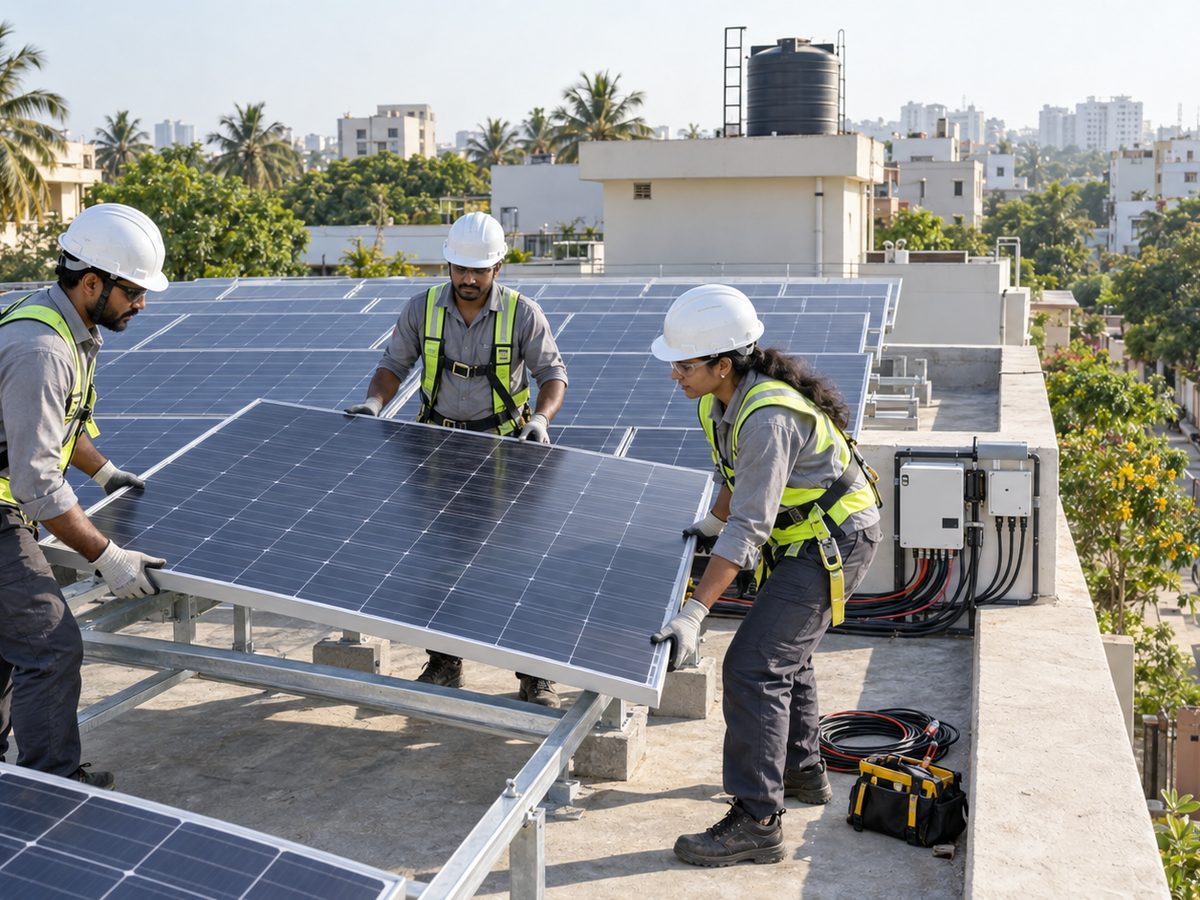
The default answer for any building with a shade-free roof and a monthly bill above about ₹2,500. Your array powers the building first; the surplus goes to the DISCOM through a bi-directional meter and comes back as credit at night.
There is no battery, nothing to replace and almost nothing to maintain beyond cleaning. That simplicity is why grid-tied systems have the shortest payback of anything we build — and why we will always model this option first, even when you came asking for something more elaborate.
| System | Roof area | Annual units | Suits a bill of |
|---|---|---|---|
| 3 kW | ~240 sq ft | ~4,350 kWh | ₹2,500 – ₹3,500 |
| 5 kW | ~400 sq ft | ~7,250 kWh | ₹4,000 – ₹5,500 |
| 10 kW | ~800 sq ft | ~14,500 kWh | ₹8,000 – ₹11,000 |
| 50 kW | ~4,000 sq ft | ~72,500 kWh | ₹40,000 – ₹55,000 |
Indicative only, at 1,450 kWh per kW per year. Actual sizing follows your twelve-month consumption and shade profile.
02 — Off-grid & hybrid
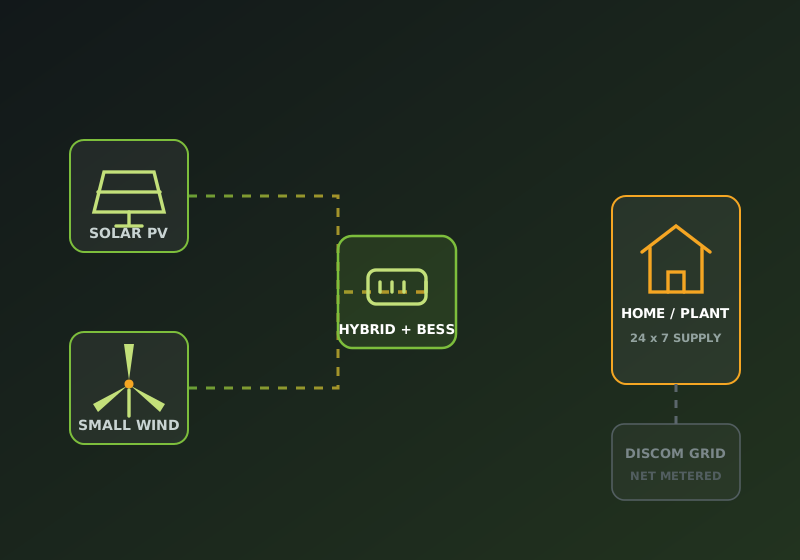
A hybrid inverter treats solar, wind, battery and grid as four inputs to one decision: what should power this building right now, at the lowest cost, without an interruption.
For sites where an outage is expensive — operation theatres, server rooms, cold chains, hospitality — storage is not a luxury. Configured properly it also displaces diesel, shaves the demand peaks that drive your maximum-demand charge, and lets you buy from the grid when it is cheapest.
03 — Utility scale
When the roof runs out or the load is large enough to justify land, the engineering shifts from mounting brackets to civil works, evacuation and wind loading. We build for that.
Ground-mount projects live or die on the studies done before anything is procured: soil bearing capacity, flood and drainage behaviour, row spacing against inter-row shading, module cleaning water logistics, and the distance and voltage of the evacuation route. We do those studies first and put them in the proposal.
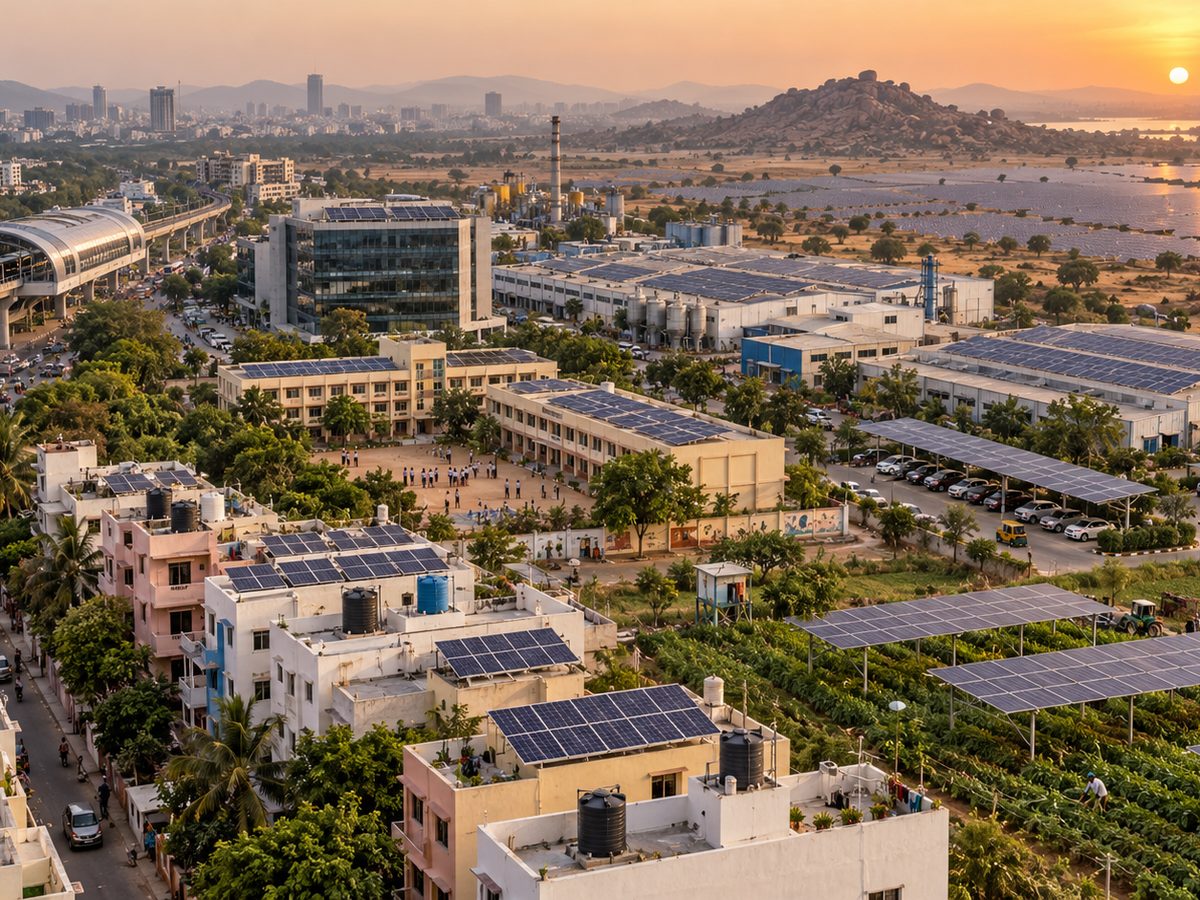
Irradiation, terrain, soil, drainage and evacuation assessed before a single module is specified.
P50 / P90 generation estimates and a financial model your lender or board can actually review.
04 — Commercial & industrial
Industrial tariffs rise faster than residential ones, and industrial roofs are large, flat and unshaded. That combination makes C&I solar the most financially obvious project on most MSME balance sheets — and the most often deferred.
Metal-sheet and RCC roof mounting with non-penetrative or sealed-penetration fixings, engineered for the sheet gauge and purlin spacing you actually have.
Car parks, yards, effluent ponds and walkways generating overhead while the space below stays fully usable — and shaded.
Storage sized against your maximum-demand profile, so the saving comes from demand charges as well as energy charges.
| Model | Who owns the plant | Your investment | Best when |
|---|---|---|---|
| CAPEX | You do, from day one | Full project cost, with accelerated depreciation benefit | You have the capital and want the full 25-year saving plus the asset on your books |
| OPEX / RESCO | SunX or a funding partner | Nil — you pay only for units generated, under a long-term PPA | Capital is committed elsewhere and you want a tariff below your DISCOM rate immediately |
| Deferred / blended | Transfers to you over the term | Part payment now, the rest through generation | You want ownership eventually but a softer first-year outflow |
| Group captive | A special-purpose vehicle you part-own | 26% equity in the generating company | Consumption is large enough to justify open access and cross-subsidy relief |
Model availability depends on project size, credit profile and DISCOM regulations current at the time of signing. We will tell you which options your project genuinely qualifies for.
05 — Operations & maintenance
A solar plant rarely fails outright. It fades — a soiled array here, a dead string there, an inverter derating in the heat — and unless somebody is watching the numbers, the first sign is a bill that stopped falling.
Our maintenance contracts are built around measurement. Every plant reports its performance ratio against the model we sold you, and every month you get that comparison in one page. We also take on plants built by others: a health check, a diagnosis, and a written revival plan with what it will cost to get the yield back.
Also delivered by SunX
Rarely the reason a client calls, frequently part of what we end up delivering.
AC and DC surface and submersible pump sets from 1 to 25 HP for farms, apartments and estates, with controller and dry-run protection.
All-in-one and split LED luminaires with LFP batteries and dusk-to-dawn control for roads, layouts and industrial perimeters.
Energiser-based perimeter fencing for farms, plants and ground-mount sites — a safe deterrent that runs without grid supply.
AC chargers wired behind your solar and storage, so vehicles charge on self-generated units rather than peak-tariff grid power.
Adding an LFP bank and hybrid inverter to an existing grid-tied plant, giving you back-up without rebuilding the array.
Load profiling, tariff-slab analysis and a recommendation that occasionally concludes efficiency should come before generation.
Scope clarity
Every one of these is in the scope of a standard rooftop installation. If a competing quote is materially cheaper, this list is usually where the difference is hiding.
| Stage | What we deliver |
|---|---|
| Survey | Roof measurement, shadow logging across the day, twelve-month bill analysis, sanctioned-load and phase check, structural walk-through. |
| Design | Module layout, single-line diagram, string configuration, cable schedule with loss budget, earthing and lightning-protection design, generation model. |
| Documentation | Itemised bill of materials with make, model and warranty term for every component — issued before payment, not after. |
| Approvals | National Portal / PM Surya Ghar registration, DISCOM feasibility and net-metering application, vendor mapping, inspection follow-up. |
| Supply | Modules, inverter, mounting structure, DC and AC cabling, protection devices, combiner boxes, earthing kit, lightning arrestor, walkways where needed. |
| Installation | Structure fabrication and fixing, module mounting and torquing, DC and AC wiring, inverter and protection installation, earthing, cable management and weather sealing. |
| Commissioning | Insulation, polarity and continuity tests, inverter configuration, meter-change coordination, monitoring app set-up, generation verification. |
| Handover | Drawing set, test reports, warranty certificates, monitoring credentials and a walkthrough of what each reading means. |
| After | First two cleaning cycles, performance review at three and twelve months, and an O&M contract you can take or leave. |
Next step
A photograph of your latest bill and your pin code is enough for an indicative size, cost and payback. The site survey confirms it.